In recent years, the Supreme People's Court of the People's Republic of China (hereinafter referred to as Supreme People's Court) has opened up a path of judicial innovation with Chinese characteristics in the service of the people through overall and systematic planning under the leadership of Chief Justice Qiang Zhou, achieving remarkable progress in smart litigation, smart trial, smart execution, and smart management. During the Fourteenth Five Year Plan period, attention should be paid to new interests and demands of the people, and new AI technologies such as digital twin technology, extended reality technology, privacy computing technology, and affective computing technology should be fully used. In this way, the construction of smart courts at a higher level and involving wider aspects can be pushed forward in a systematic manner to further improve the intelligent application system of the court and innovate the governing measures concerning judicial data, thus actively promoting the participation of multiple parties in society and creating a collaborative ecology for the construction of smart courts.
Expert report
Practical Application and Prospects of AI Technology in the Construction of Smart Court
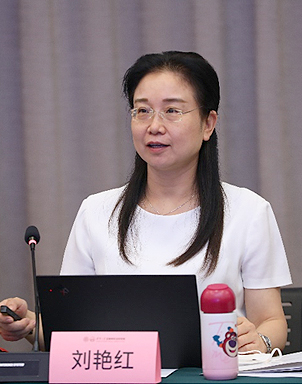
Yanhong Liu, Professor, Dean, China University of Political Science and Law School of Criminal JusticeExpert Introduction
Yanhong Liu, Dean of China University of Political Science and Law School of Criminal Justice, a professor of Qian Duansheng Lecture of China University of Political Science and Law, Chief Editor of Tribune of Political Science and Law, a selected 7th National Top 10 Outstanding Young Jurist, an accredited talent of the National Hundred-Thousand-and Ten Thousand Talents Project, a winner of the title of Young and Middle-Aged Expert with Outstanding Contributions, an expert enjoying Special Government Allowances of the State Council starting from 2018, and an accredited member of the Program for New Century Excellent Talents in University supported by the Ministry of Education, focuses on criminal law, integration of civil law, administrative law and criminal law, supervision law, big data, and Internet law in her research. She has published multiple academic works including Study on Legal Dogmatics of Cybercrime and Substantive Theory of Criminal Law and edited multiple textbooks including Criminal Law, in addition to the publication of more than 200 articles on Social Sciences in China, China Legal Science and other journals. She is also a winner of the First Prize of the 6th Science Research Famous Achievement Award in Higher Institution (Humanities and Social Sciences) of the Ministry of Education, the First Prize of the 12th and 15th Outstanding Philosophical and Social Science Achievement Award of Jiangsu Province, the title of Advanced Individual Worker [Outstanding Member of the Communist Party of China (CPC)] of Jiangsu Province, etc.