AI has witnessed the formation of two types of paradigms, namely rationalism and empiricism, in its development, with the former featured with high pertinence but poor adaptability while the latter with strong adaptability but poor generalization and interpretability. With the development of big data, data can be obtained in a comparatively convenient and cheap manner, contributing to dramatic progress in data-driven methods of empirical paradigm such as deep learning. Nevertheless, deep learning is still subjected to certain limitations, for instance, natural long-tailed distribution of data in most circumstances. The use of the mock-up has significantly alleviated this limitation on deep learning, enabling deep learning to learn from large-scale unlabeled data. In our development of Lawformer (a mock-up of law), tens of millions of legal instruments were used for pre-training to construct the general competency of the model. Experimental verification tests were performed on judgment prediction, class case retrieval, reading and comprehension, and judicial examination to reveal that all mocks-up can achieve better outcomes compared with conventional methods.
Expert report
Legal Knowledge-Guided Big Models and Applications
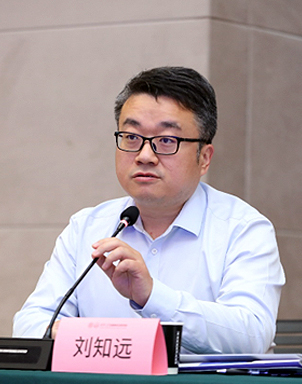
Zhiyuan Liu, Associate Professor, DCST, Tsinghua UniversityExpert Introduction
Zhiyuan Liu, an associate professor and doctoral supervisor of the DCST, Tsinghua University, focuses on natural language processing, knowledge graph, and social computing in his research. He was conferred a doctorate by Tsinghua University in 2011, and has published more than 100 articles on famous international journals and conferences on AI including the Association for Computational Linguistics (ACL), Conference on Empirical Methods in Natural Language Processing (EMNLP), International Joint Conference on Artificial Intelligence (IJCAI), and the Association for the Advancement of Artificial Intelligence (AAAI), with a number of bibliographic citations of more than 20,000 times by other authors according to Google Scholar statistics. He is the winner of the First Prize of the Natural Science Award of the Ministry of Education (as the second completer), the First Prize of the Qian Weichang Science and Technology Award for Chinese Information Processing, CIPSC (as the second completer), and the CIPSC Hanvon Youth Innovation Award, and has been selected as a Top Young Talent of the National Ten Thousand Talents Plan, a young scientist of the Beijing Academy of Artificial Intelligence (BAAI), and a highly cited Chinese scholar recognized by Elsevier in 2020. In addition, he has also been accredited into the List of 35 Scientific and Technological Innovators in China under the Age of 35 by MIT Technology Review and into the Young Elite Scientists Sponsorship Program by the China Association for Science and Technology. He currently serves as the Director of the Youth Work Committee, the Secretary-General of the Social Media Processing Special Committee of CIPSC, the Deputy Editor in Chief of AI Open, and the chairman of ACL, EMNLP, International Conference of World Wide Web (WWW), International Conference on Information and Knowledge Management (CIKM), and International Conference on Computational Linguistics (COLING).