As to human-centered intelligent information services, many innovative technologies have been studied. For example, a novel model called TSQA is developed for temporal reasoning, which uses reasoning based on a time-aware temporal knowledge graph to anticipate timestamp information in natural language. The OPERA model is designed for numerical reasoning to predict lightweight discrete operators that may then be softly executed to get an answer, improving numerical reasoning and interpretability. Additionally, the SAE approach is suggested for multi-hop reasoning, which allows for precise evidence (documents/sentences) selection as well as genuine logical linkages concatenated in multiple documents for reasoning. Jingdong has developed intelligent legal platforms such as "Jingdong Dongdong" intelligent law robots and Jingdong intelligent customer service as a result of these efforts. In addition, a number of intelligent applications for courts have been offered using AI technology, including indoor file delivery robots lessening the workload of case managers, facial recognition smart gates serving as assistants for self-service registration and diversion, various business enabling the general public to handle the whole process of litigation without having to leave their homes, and virtual reality panorama litigation service halls.
Expert report
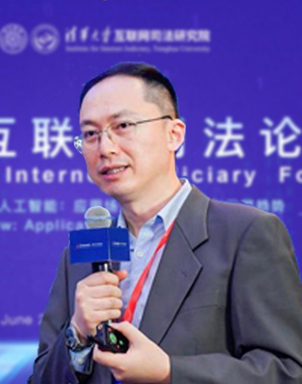
Human-Centered Intelligent Information Service
Xiaodong He, Deputy Managing Director of JD AI Research, Technical Vice Preseident of JD.COMExpert Introduction
Xiaodong He, Technological Vice President of JD Group, Standing Vice President of JD Artificial Intelligence Institute, Director of the Deep Learning and Speech and Language Laboratory, an accredited IEEE Fellow, an adjunct professor at Chinese University of Hong Kong (Shenzhen), University of Washington (Seattle) and Tongji University (Shanghai) and an honorary professor at Central Academy of Fine Arts (Beijing), and former chief researcher and head of the Deep Learning Technology Center of Microsoft Redmond Institute, focuses on AI field, including deep learning, natural language processing, speech recognition, computer vision, IR, and multimodal intelligence. He has published more than 100 articles on subjects including deep structured semantic model (DSSM), hierarchical attention network (HAN), and attentional generative network (AttnGAN), which have been cited for more than 10,000 times according to Google Scholar statistics with his research outcomes applied to a broad range of tasks involving language, vision, IR, and knowledge representation. He is also a selected IEEE Fellow.